A practical guide to sports betting bonuses and free bets: how core promotional formats work, worked SNR versus SR payout math, essential terms to check, and how to compare offers responsibly.

Sports Betting Bonuses & Free Bets Explained: Types, Terms and How to Compare Offers

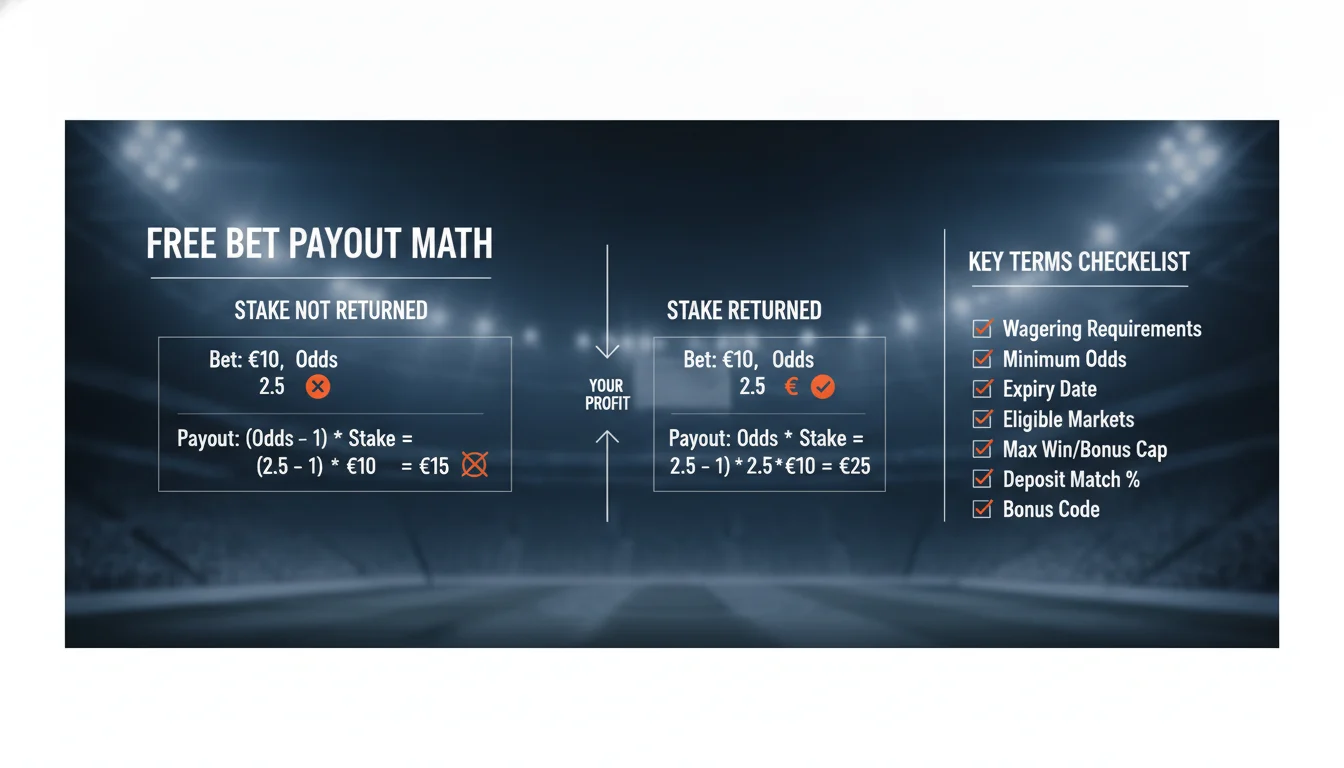
Understanding sports betting bonuses and free bets starts with looking past headline percentages and maximum caps. Two promotions that advertise the same nominal value can behave very differently once minimum odds, settlement rules, payment exclusions, and expiry windows are applied.
This guide from KSABetting breaks down how sportsbook promotions operate in plain terms, shows the exact payout math behind common free-bet formats, and gives readers a neutral checklist for comparing offers alongside long-term platform quality.
How Sports Betting Bonuses Differ from Casino Promotions
Sportsbook promotions are governed by event outcomes, market settlement, and odds thresholds rather than instant game rounds or spin counts. A wager on a football match, tennis set, or basketball game typically stays open until the underlying event officially concludes and settles, which affects when bonus funds unlock or expire.
In addition, sportsbooks routinely enforce minimum odds requirements on both qualifying wagers and bonus bets so promotions are not placed on heavy favorites with minimal risk. Evaluating a sports offer properly means reading those mechanics alongside the platform’s baseline odds and withdrawal reliability, as outlined in KSABetting’s How to Compare Sports Betting Sites: A Beginner Checklist.
Main Types of Sports Betting Bonuses Explained
Sportsbooks structure promotions around different incentives for new and existing accounts. Knowing which category an offer belongs to helps clarify whether you are receiving locked bonus credit, a conditional refund token, or improved pricing on a selection.
Matched Deposit Welcome Bonuses
A matched deposit bonus credits promotional funds equal to a percentage of an initial deposit, up to a stated ceiling. For example, a 100% match up to a set cap doubles the starting promotional balance if you deposit the maximum qualifying amount, though smaller deposits still receive the same percentage match.
Most platforms separate real cash balance from bonus balance and attach rollover or playthrough rules before bonus funds or related winnings can be withdrawn. You can review how playthrough multipliers work in detail in KSABetting’s Sports Betting Bonus Wagering Requirements & Rollover Explained.
Free Bets and Bet Credits
Free bets or bet credits are promotional tokens that let you place a wager without deducting cash from your main deposit balance. When a free bet loses, your cash balance is unaffected; when it wins, settlement rules determine whether you receive net winnings only or winnings plus stake.
Operators sometimes issue free bets as a single token or split them into smaller tranches, and they may restrict them to specific sports, markets, or match types.
No-Sweat and Second-Chance First Bets
Often marketed as a no-sweat bet, second-chance bet, or first-bet refund, this structure applies when your first qualifying cash wager loses. Instead of receiving nothing, you receive a refund—most commonly as a free bet token rather than withdrawable cash.
If the initial qualifying wager wins, the promotion generally ends and you simply keep the normal winnings from that bet.
Odds Boosts and Enhanced Prices
Odds boosts increase the price offered on a specific market or selection above the standard market quote. Some boosts are pre-selected by the sportsbook on featured matches, while profit-boost tokens let you apply a percentage increase to potential winnings on an eligible bet slip.
Boosted markets frequently carry maximum stake limits and may be excluded from certain multi-bet or accumulator combinations.
Accumulator Boosts and Acca Insurance
Accumulator boosts add a percentage bonus to the payout of a winning multi-selection bet slip, often scaling up as you add more qualifying legs above a minimum odds floor per leg. Acca insurance, by contrast, refunds a losing accumulator—typically as a free bet up to a cap—if a specified number of legs win and only one leg lets the slip down.
Sportsbook Cashback and Reload Offers
Reload bonuses reward subsequent deposits after the welcome stage using a deposit match or recurring free bet. Sportsbook cashback returns a percentage of net losses over a defined window, such as a week or a specific competition, usually credited as bonus funds or bet credits rather than unrestricted cash.
Free Bet Payout Math: Stake Not Returned (SNR) vs. Stake Returned (SR)
The single most important distinction in free-bet math is whether the promotional stake is Stake Not Returned (SNR) or Stake Returned (SR). Most standard sportsbook free bets are SNR, meaning the token value itself is not included in a winning payout.
Using decimal odds, a standard cash bet returns Stake x Odds (giving a net profit of Stake x (Odds - 1)), whereas an SNR free bet pays only Stake x (Odds - 1) on a win and 0 if it loses. You can see how decimal pricing converts into payouts in KSABetting’s Sports Betting Odds Explained: Decimal, Fractional and Implied Probability.
Consider a 20 unit free bet placed at decimal odds of 2.00 versus 3.50:
- At 2.00 decimal odds (SNR): A winning bet pays
20 x (2.00 - 1) = 20net profit. If the same20unit stake were SR, a win would return20 x 2.00 = 40total (20profit plus the20stake). - At 3.50 decimal odds (SNR): A winning bet pays
20 x (3.50 - 1) = 50net profit. If SR applied, a win would return20 x 3.50 = 70total (50profit plus the20stake).
Because the 20 unit stake disappears on an SNR win regardless of price, higher decimal odds represent a larger share of total return as net profit compared with low odds near 1.50 or 2.00. However, higher odds also carry a lower probability of winning, so choosing longer prices for SNR tokens is a mathematical trade-off rather than a guarantee of profit.
Comparison Matrix: Evaluating Sportsbook Offer Structures
Comparing promotions side by side helps clarify what each structure requires upfront and where hidden friction tends to appear.
| Offer Type | Upfront Deposit Needed | How Winnings Are Calculated | Typical Restrictions | Best-Fit User Profile |
|---|---|---|---|---|
| Matched Deposit Bonus | Yes (qualifying deposit) | Bonus funds added; cash withdrawal usually requires rollover | Rollover multiplier, min odds, expiry window, payment exclusions | Readers comfortable tracking wagering turnover over time |
| Free Bet / Bet Credit | Often yes (qualifying bet) or promo-issued | Usually SNR (net profit only); rare SR returns stake | Min odds, single/multi rules, sport/market locks, short expiry | Readers testing markets with bounded token risk |
| No-Sweat First Bet | Yes (initial cash wager) | Cash if first bet wins; refund token if first bet loses | Refund cap, credited as free bet rather than cash, min odds | Readers placing a single initial wager who want a fallback |
| Odds / Profit Boost | Yes (funded bet slip) | Higher odds or percentage boost on winning profit | Max stake cap, selected markets, excluded combinations | Readers already planning a specific match or slip |
| Acca Boost / Insurance | Yes (multi-leg slip) | Extra payout % on win, or refund token if one leg misses | Minimum legs, min odds per leg, refund cap | Readers who already build multi-selection slips |
| Cashback / Reload | Yes (net loss period or new deposit) | Percentage of net losses or matched deposit credit | Calculation period, eligible sports, bonus conversion rules | Returning users comparing ongoing perks |
7 Critical Terms to Check Before Claiming Any Sports Bonus
Headline numbers rarely tell the full story. Before opting into any sportsbook promotion, check these seven terms in the offer rules:
- Minimum qualifying odds: Check the lowest decimal or fractional odds allowed on both the qualifying bet and the bonus bet itself; placing a wager below the threshold may fail to count.
- Eligible bet types and markets: Verify whether singles, multiples, pre-match markets, or live in-play bets qualify, as certain niche markets or boosted prices may be excluded.
- Payment method exclusions: Specific deposit channels—such as certain e-wallets or cryptocurrency transfers—are sometimes excluded from welcome bonuses, which is worth checking alongside KSABetting’s Betting Payment Methods in Saudi Arabia: Deposits and Withdrawals.
- Rollover and playthrough rules: Confirm whether wagering applies to the bonus amount alone or deposit plus bonus, how many times it must be turned over, and which odds count toward progress.
- Cash-out impact: Using early cash-out on a qualifying bet or bonus bet can void eligibility or stop rollover progress depending on the sportsbook’s settlement rules.
- Activation and expiry windows: Note how many days you have to opt in, place the qualifying bet, and use any credited free bet or rollover balance before unused amounts expire.
- Maximum win or conversion caps: Some promotions cap the maximum profit that can be generated from a free bet or the maximum amount convertible into withdrawable cash.
How to Compare Sportsbook Offers Responsibly
A large welcome headline is not automatically better than a smaller offer with straightforward terms. Compare promotions by looking at realistic completion requirements, transparent expiry periods, and how the sportsbook performs after the initial bonus is used, including standard odds margins and smooth withdrawal processing.
Treat every promotion as optional rather than an obligation to place extra wagers. Never increase your stake size, force low-confidence selections, or bet outside your budget just to meet a rollover target or beat an expiration clock; if you want practical safeguards for managing play, review KSABetting’s Responsible Gambling Tools: Limits, Time-Outs and Self-Exclusion.
اقرأ المزيد
لم يتم العثور على مقالات
عذرًا، لا توجد مقالات أخرى مرتبطة بهذا المقال.
أحدث الكازينوهات

منصة تجمع الألعاب السريعة والسلوتس والكازينو المباشر والمراهنات الرياضية مع تصميم موجه للجوال.
منصة تجمع المراهنات الرياضية والسلوتس وألعاب Crash والكازينو المباشر في واجهة واحدة.

منصة تعتمد على العملات الرقمية وتشتهر بألعاب Crash، مع سلوتس وكازينو مباشر وقسم للمراهنات الرياضية.

منصة دولية تجمع المراهنات الرياضية، الألعاب السريعة، السلوتس والكازينو المباشر في حساب واحد.

منصة تجمع المراهنات الرياضية، الألعاب السريعة، السلوتس والكازينو المباشر مع تجربة استخدام مناسبة للجوال.

منصة معروفة بتركيزها على العملات الرقمية، وتضم ألعابًا أصلية، سلوتس، كازينو مباشر ومراهنات رياضية.



أحدث أخبار المراهنات